BREAKING NEWS

Wednesday, December 14, 2016

Unit 5 Reflection

In this unit, we learned about walking the dogma - the basics of protein synthesis, the process in which DNA becomes a protein. We did multiple labs that helped us understand the essentials of this unit, including DNA structure and function, DNA replication, and Gene expression and regulation. 

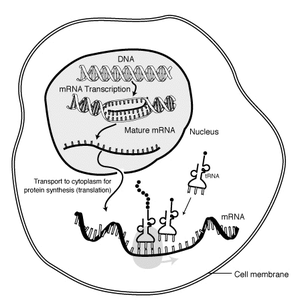
Protein synthesis has many steps. First, a copy of the DNA (deoxyribonucleic acid) is made in a process called transcription, then the copy is used to make a protein, in translation. Proteins are essential to life. The first step of translation is for a section of DNA, known as a gene, to be copied by an enzyme, in the nucleus. The copy is called messenger RNA, often abbreviated as mRNA. RNA has a few main differences form DNA: It is only single stranded, and the base uracil replaces thymine. 

After the copy is made, the mRNA leaves the nucleus and travels to the cytoplasm. Then, translation beings - the mRNA bonds with a ribosome, which will make a protein. The ribosome reads the first three bases called a codon, and determines which amino acid corresponds with that sequence. Each amino acid that is determined by the codon is read by the ribosome. Amino acids are bonded together and when the mRNA is done being translated, the amino acid chain fold up to become a protein. 

The gene expression and regulation lesson was particularly hard for me, but it was the one that I found the most interesting. The basic questions of that unit was: Why do genes appear in the correct places and at the correct times? Why don't we have eyes on our feet and toes on ours heads? And the answer was gene expression and regulation. 

Gene expression is the process of a gene being used to produce a gene product of the phenotype, basically what gene is expressed in the person. Gene regulation is a mechanism used by cells to increase or decrease the expression of a certain gene.

Another essential concept in this unit was Mutations. Although the connotation of the word mutation notes otherwise, mutations are generally very small and can have little to no effect. Is biology a mutation is a change in the DNA code. Mutations are happening almost constantly in our body. There are two main types of mutations - substitution and frameshift mutations. Substitution is when one nucleotide is substituted for another. There are two types of frameshift mutations - insertion and deletion. Insertion is when an extra base is put in and deletion is when a base is taken out.

The effect of the mutation is truly determined by where the mutation is placed. Suppose a harmful mutation to create a STOP amino acid, is placed at the front of the amino acid sequence - then the harms would be devastating. But, if the same mutation is placed near the end, then the amino acid sequence is still changed, but on a much smaller scale, thus it would not be that harmful.

One of my strengths in this unit were the labs - They really helped em visualize and understand the processes. We did a DNA extraction lab as well as a protein synthesis lab, among other things. These labs allowed me to get a full understanding of the concepts. The process of doing the lab, whether the product came out good or not, helps me understand concepts much better than reading or watching a vodcast.

One of my weaknesses in this unit were the vodcasts. Some of the vodcasts were hard to fully understand, but I was able to ask questions to my group and do the labs to make up for it. The vodcasts were especially hard because diagrams were confusing. I was not able to follow some of the diagrams, but when we did them on the board in class, I got the concepts.

Overall my growth as a learner in this unit has become tremendous, mainly because of a VARK questionnaire that I took at the end of my last unit. It told me that I was a better visual learner, and I have always known that I always understanding best when actually doing something. I feel that I have really learned what helps me understand certain concepts and how I should study in the future for science, or for any other subject. This will help me throughout my years of learning, especially as finals week comes nearer.

This unit has also taught me about how to react well to setbacks. During the DNA extraction lab, at first, I was not able to extract DNA properly, due to a mistake in our procedure. But instead of getting mad at myself, I kept my head held high and redid the lab in the correct way. I was able to finish the lab before class ended and thus, I learned how to recover form a small setback in a lab.

This unit also really helped me learn how to collaborate with others in my group. During most of my previous units I understood most of the vodcasts and there was no need, really, to discuss properly with my group about it. But in this unit, since I did not understand the vodcasts completely, I needed to collobarate with my group to make sure I got the concepts down.

Image result for substitution mutations


Monday, December 12, 2016

Protein Synthesis Lab

In this lab, we asked the questions, "How does the body produce proteins and What kinds of mutations cause the greatest damage to the structure of a protein?" To answer these questions, we followed the steps of protein synthesis, throughout transcription and translation.

Protein production can be sorted into two main steps, with multiple substeps. First, a copy of the DNA (deoxyribonucleic acid) is made in a process called transcription, then the copy is used to make a protein, in translation. Proteins are essential to life. The first step of translation is for a section of DNA, known as a gene, to be copied by an enzyme, in the nucleus. The copy is called messenger RNA, often abbreviated as mRNA. RNA has a few main differences form DNA: It is only single stranded, and the base uracil replaces thymine. After the copy is made, the mRNA leaves the nucleus and travels to the cytoplasm. Then, translation beings - the mRNA bonds with a ribosome, which will make a protein. The ribosome reads the first three bases called a codon, and determines which amino acid corresponds with that sequence. Each amino acid that is determined by the codon is read by the ribosome. Amino acids are bonded together and when the mRNA is done being translated, the amino acid chain fold up to become a protein.


"Protein Biosynthesis." Wikipedia. Wikimedia Foundation, n.d. Web. 12 Dec. 2016. <https://en.wikipedia.org/wiki/Protein_biosynthesis>.

Of the mutations that we tested in this lab, I was able to conclude that each mutation could be nearly as harmful as every other mutation, depending on of the situation, the code, and when the mutations occur. We tested three types of mutations - substitution, insertion and deletion. The effect that substitution caused varied - only being extremely harmful when placed in a certain position. Otherwise, substitution is generally harmless. Insertion and deletion followed a similar pattern. When put near the start of the sequence, the change did quite a bit of damage, but when placed at the end, not much damage occurred.
substitution


"What Types of Mutation Are There?" Facts. The Public Engagement Team at the Wellcome Genome Campus, 25 Jan. 2016. Web. 12 Dec. 2016. <http://www.yourgenome.org/facts/what-types-of-mutation-are-there>.

When I chose my mutation I chose to replace the first G with the First T, as I wanted to see what happened if one of the early letters was changed. What ended up happening was that, the stop codon (UAA) was the second amino acid in the sequence, after MET, the start codon. This would have a devastating effect, especially if the protein was important, as it would not be able to make the protein. This shows why the place that the mutation is located can have a really big effect. Earlier in the lab we did a mutation at a different place in the same sequence and there was not a single effect on the amino acid sequence.
Image result for mutation

"What Types of Mutation Are There?" Facts. The Public Engagement Team at the Wellcome Genome Campus, 25 Jan. 2016. Web. 12 Dec. 2016. <http://www.yourgenome.org/facts/what-types-of-mutation-are-there>.

Because proteins are so essential to life as they play a part in almost every activity we do, mutations can sometimes be extremely harmful, especially if it greatly alters the amino acid sequence formed by the mRNA sequence. But it is also important to note that mutations happen often on a daily basis, and that most mutations are not as harmful. One example of a disease caused by mutations is phenylketonuria, abbreviate PKU. PKU is an incurable, chronic disease, that although rare, can cause great damage to the body. It is a birth defect that causes an amino acid called phenylalaline to build up in the body, which can lead to brain damage, intellectual disabilities, behavioral symptoms or seizures. PKU is an autosomal recessive disease caused by a mutated gene for the enzyme phenylalanine hydroxylase (PAH), which converts the amino acid phenylalanineto other essential compounds in the body.

Image result for phenylketonuria
"Phenylketonuria." U.S. National Library of Medicine. National Institutes of Health, n.d. Web. 12 Dec. 2016. <https://ghr.nlm.nih.gov/condition/phenylketonuria>.

Friday, December 2, 2016

DNA Extraction Lab

In this lab, we asked the question, "How can DNA be separated from cheek cells in order to study it?" We collected information about the three main steps of DNA extraction. Homogenization, lysis, and precipitation. We found that DNA from cheek cells could be extracted and studied if the correct steps are used in the correct order. The correct steps the proper order are as follows:
  1.  Measure 2.5mL of Gatorade into a paper cup
  2.  Scrape both sides of the inside of your checks using your teeth.
  3.  Vigorously swish in your mouth for 30 seconds.
  4.  Spit solution back into cup
  5.  Add a tiny punch of salt
  6.  Carefully poor solution into a test tube about 1/3 to 1/2 of the way up
  7.  Add 10 drops of detergent/soap.
  8.  Add 5-10 drops of your enzyme (pineapple juice)
  9.  Let sit for 5 minutes and record observations.
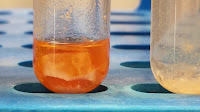
  10.  Tilt the tube at an angle and slowly add cold alcohol along the side of the test tube. You do not want the two layers to mix. The amount added should be about the same as the Gatorade mixture.
  11.  Collect the DNA and alcohol and carefully, with a transfer pipette, and place in a microcentrifuge tube. Do your best to only transfer DNA and Alcohol to your tube.
  12. Cover the tube with your thumb. Carefully invert 6 times. Be careful not to shake too much. You do not want soapy bubbles to form.
  13. Wait for another 5 minutes and record observations. 
Evidence from Experiment: During our first trial we switched steps 11 and 12, and thus we were not able to extract DNA, but when we did these steps in the correct order, we were able to extract DNA.

Reasoning: This evidence supports our claim, because during the first trial, which failed, the two layers, of alcohol and Gatorade, mixed and thus we were not able to separate DNA. However during the second trial which succeed we only inverted the tube after separating DNA, and thus was able to get the DNA.

Possible Error 1: The first error that we made was switching the order of the steps. Part of our lab was to put random steps in the correct order. We ended up switching steps 11 and 12, thus inverting the tube 6 times (and mixing the alcohol and Gatorade solutions), before separating the DNA. The effect of this error on the overall results was the fact that we were not able to get the DNA separate and the end of the experiment.

Possible Error 2: That was the only error we made in the experiment, but a hypothetical error could have been not adding the alcohol while the test tube was tilted. The effect of this would have been the same as the effect in PE 1, as the DNA would not separate at the end of the experiment.

This lab was done to help us understand the process of DNA Extraction, including the 3 main steps - homogenization, lysis and precipitation. I can relate this lab to the vodcast about "Your Genetic Code." The concepts from that vodcast, really helped me to do this lab, and my overall understanding of DNA was solidified through this lab process. The fact that we first messed up and then fixed our mistakes, really helped me understand some of the important concepts, like the enzymes breaking down the DNA.

From this lab, I learned the correct process of DNA extraction, and now I could extract DNA from any cell. This would be helpful if I wanted to study DNA, especially discrepancies in genetic variation, in the future as a scientist. Another outcome I learned from this lab is to slow down. At first, I though for sure that the first procedure we came up with was correct, but in hindsight, I feel like if I thought about it a bit more, I would have been able to see the mistake and correct it before we started the experiment. This teaches me to double check everything I do, and most importantly, slow down.


Sunday, November 27, 2016

Unit 4 Reflection

Coin Sex Lab


  • What did you do in this lab? How did coins serve as a model for genetics concepts?
  • Compare your expected results with actual results in your dihybrid cross simulation. To what can you attribute these results? (ie, make a claim and back it with reasoning).
  • What is the limit of using probability to predict our offspring’s traits?
  • How does understanding this relate to your life? Be specific

In this lab we predicted the outcomes of different types of crosses, by flipping coins to get phenotype. Each coin represented an gene, such as hair color, each side of the coin, heads and tails, represented alleles, such as blonde hair color or brown hair color.


We worked in partner groups and each person was given either 1 or two coins. Each person represented a parent and each person's coins represented the genes of each parent. When one person flipped their coins in the air, it represented meiosis.


The process of putting together the coin flip outcomes and showing them in terms of phenotype , that process simulated, sex or recombination.


We simulated multiple different crosses, including mono hybrid, and dihybrid crosses. For our dihybrid cross simulation, we received different than expected results. Because we only flipped these coins 10 times, the results were a bit skewed due to lack of testing, but the main reason was that the resulting phenotype of any cross at the end is, - random.

This creates a limit for using probability to predict our offspring's traits. Although we may be able to assume our offspring have a better chance of getting a specific trait, in the end it is all random, so we can never be 100 percent sure that our offspring will receive a certain trait. This is mainly because of Gregor Mendel's Law of Independent Assortment.

This lab relates to my life, because it educated me a lot about how traits get passed on and how we cannot predict it. All my life, I have always assumed that I have gotten my traits from just my mom and my dad, but now I know that is not true. Traits can skip generations, because of the randomness in Mendel's law of Independent Assortment. I also know now that I cannot predict what traits anybody's offspring might have.

In this unit we learned all about genetics, sexual vs asexual reproduction, cell growth and cell division, inheritance - autosomal vs X Linked, etc. We also learned about dominance vs recessive, and how sometimes there are exceptions and complications to every rule. In the instance of dominant vs recessive, some of the exceptions were codominance and incomplete dominance. We learned about mitosis, meiosis, and spent a lot of time comparing the two, their similarities and their differences.

One of my strengths in this unit was punnent squares. It was generally really easy for me to visualize the results, however I did not always get expected results in the punnent square or in any of our labs. That was probably one of my greatest weaknesses - assuming something would happen without testing it first. Time and time again in this unit my hypothesis was proven wrong when I actually tested out my work. Another one of my weaknesses was understanding the law of Independent Assortment. I originally though that the phenotype of the parents is automatically passed on to the offspring, and I had a hard time understanding that the recessive allele, the one parents are carriers for but don't exhibit, has the same chance to be passed on to the offspring as the dominant alleles.

Our genetics infographic really helped solidify my understanding of some concepts. The research portion, especially finding images allowed me to look at different sources and see different persepctives about concepts. I feel like this was one of the units I understood the best, because of the infographic.

I would love to learn more about genetic exceptions and complications, especially mutlifactorial disorders. Is there a way to mask the multifactorial disorder, and how badly can the environment affect a persons to change their behavior? Is there a way to predict multifactorial disorders, and what are ways to fix them?

My VARK Questionnaire scores were:

  • Visual: 18
  • Aural: 15
  • Read/Write: 16
  • Kinesthetic: 15
You have a multimodal learning preference. (VARK)

Most of the above results did not surprise me, as I have always been able to grasp ideas in many different ways, however, I was extremely surprised that the best way of learning for me was visual. I always thought physical activity or reading was my best way of grasping knowledge.

Because of this, I am going to use many videos, and diagrams to quiz myself in reparation for my upcoming test. I generally read textbook, articles online in preparation for tests, but hopefully my new idea of visual learning will help me better.

Image result
Dihyrbid Cross

Image result for law of independent assortment
The Law of Independent Assortment


Sunday, October 30, 2016

Is Sexual Reproduction Important?

In this blog post I will answer and provide supporting evidence for the question, Is Sex Important? And the short answer is yes. I will delve further into the reasoning and evidence for this answer in four main categories. The benefits of reproducing sexually, the costs of reproducing sexually, the benefits of reproducing asexually and the costs of reproducing sexually. Finally I will summarize all my points and justify why reproducing sexually is the better and safer way to reproduce.

Benefits of reproducing sexually:

Because of the concept of natural selection, genetic variation is crucial to survival. Without genetic variation, there is no evolution, and thus no survival. Genetic variation comes from two main sources mutation and sex.

Sexual Reproduction Benefit 1:

Sexual reproduction is the more sophisticated form of genetic variation. Mutations are random changes to information contained in genes, and is more primitive than sexual reproduction. Mutations only arise from errors made by the cells genetic copying machinery.

Make no mistake, sexual reproduction only produces combinations of genes that already exist, whereas mutation creates altogether new genes, and thus is necessary for generating the raw material of evolution. According to Dr. Tatiana, "Without mutation, evolution would grind to a halt"

Sexual Reproduction Benefit 2: 

Although mutations may be necessary, mutation alone is not enough. When organisms evolve to give up sex, and reproduce asexually instead. (I will explain more about the benefits and harms of asexual reproduction in the following sections, thus is just a comparison between sexual and asexual reproduction)

When an organism reproduces asexually, the differences between a parent are a child, are only due to mutation. According to Dr. Tatiana, "At first, these organisms often flourish. But their glory is fleeting. For reasons that remain mysterious, the loss of sex is almost always followed by a swift extinction."

Although there is one exception to this rule, the need for new combinations of genes that already exist are necessary, and without sexual reproduction, organisms cannot flourish. Most organisms need both sexual reproduction and mutations to properly survive and evolve.

Sexual Reproduction Benefit 3:

The final benefit of sexual reproduction is the ability to reproduce diverse offspring. I previously touched about this at the end of my first point, when I mentioned that in asexual organisms, mutations account for every difference in an organisms genetic makeup.

However, I never applied the importance of this to why sexually reproducing diverse offspring is good and why only mutational differences are bad. I will get to the cons of mutations differences in the "Asexual Reproduction costs," but for now, I will explain why having diverse offspring is helpful.
When having diverse offspring, organisms can ensure that the offspring will always be a combination of the two parents' genes and will never be the exact same, whereas in asexual reproduction, you can never control when mutations should happen.

For example if there is a poison in the environment, and for an organism to survive they need a particular gene. Asexual reproduction might take centuries for that organism to undergo a mutation that gives them that gene, and by the time that might happen, the organism will probably be extinct.
According to Dr. Tatiana, "More often than not, however, some individuals are fortunate and have a gene to resist the poison. Since these individuals are the only ones fo survive and reproduce, the genetic makeup of the population will shift to one where everybody is resistant.

Basically what this means is that sexual reproduction allows organisms to create offspring with genetic variation that might have the gene that resists the poison - If an organism does not have the necessary gene, but their mate does, then the offspring will have a good chance at getting the necessary gene and surviving the poison. Although this is not guaranteed, sexual reproduction allows organisms a better chance to survive the poison.

Sexual Reproduction Benefit 4:In my last point I discussed, how sexual reproduction would give organisms the ability to protect against a poison already spreading through the environment. They did this by mating with other organisms of their species that had a protective gene, to create an offspring that would survive.
This point is similar but it talks about how the genetic variations that sex provides with every reproductions, helps species and organisms survive - you could call it a contingency plan of sorts for the organism to almost always live on.

Genetic variations in every organism, allow each an every organism to have certain genes that protects them against almost any situation. According to Dr. Tatiana, "Monocultures are vulnerable to disease because all the individuals are the same clone," however, sexually reproducing organisms are not as vulnerable, because at least one of the organism should have the necessary genes to protect against anything.

This ensures that organisms that use sexual reproduction, will always survive any attack or poison, and live long, as all of them have different genetic makeups. The only reason that a sexually reproducing organism to go extinct is a drastic change in the habitability of their environment.

Sexual Reproduction Cost 1:

Sexual reproduction is hard to accomplish, and sometimes is a dangerous process. As opposed to asexual reproduction, sex requires two mates. This means that organisms have to seduce each other in order to reproduce sexually. 

According to Dr. Tatiana, "the competition for mates is often exceedingly stiff." Creatures might need to wear gaudy costumes, sing for hours on end, or perform prodigious feats to get a mate. Worse, the competition for mates is often at odds with survival. If you are a bird, flaunting an enormous tail may make you quite the cock among hens, but it also may make you lunch for a cat.

Sexual Reproduction Cost 2:

Another problem in the process of sexual reproduction is the time it takes, not only to find a mate, but to give birth to another organism. Although the time it takes to give birth to the organism may differ among different species, the time it takes to find a mate is never quick nor easy, as explained in my last point.

Asexually reproducing organisms do not need to find a mate, thus the time it takes for them the produce offspring is significantly shorter than the time is takes a sexually reproducing organism to do the same. 

Additionally the chance to make clones, or produce multiple offspring, although possible is very rare in sexually reproducing organisms. In asexually reproducing organisms, there is a much higher chance is producing multiple offspring each time. 

Furthermore, in sexually producing organisms, for example humans, there is usually a time limit between reproducing multiple times, whereas in asexually reproducing organisms, there is usually no time limit. Thus populations of asexual organisms usually grow at a much faster rate, than sexually reproducing organisms.

Asexual Reproduction Benefit 1:

Asexual organisms can reproduce faster and more effectively than sexually reproducing. According to Dr. Tatiana, "Sex may be fun, but cloning is much more efficient. All else being equal, an asexual female who appears in a population should have twice as many offspring as her sexual counterpart."

The reasoning for this is because in a sexual population, for example the human population, each female must have two children for the population to stay the same size. To cause the population to grow, each female in the population needs to average more than 2 children. If females average less than 2 children in a sexually reproducing population, the population will automatically shrink.

However, if an asexual female reproduces, it ensures that the population size will be maintained. If the organism reproduces more than once, then the population will automatically grow.

Asexual Reproduction Benefit 2:

Asexual reproduction is easy and does not take much time, while still allowing asexually reproducing species to produce multiple mates.

In asexual reproduction there is not necessity to find a mate, significantly lowering the time and difficulty it takes to reproduce. Additionally the reproduction itself does not take as much time as sexual reproduction. 

Another benefit that comes with the time factor is the quantity. Because of the shortened time and small amount of difficulty, asexually reproducing species can reproduce many more offspring in a small amount of time that sexually reproducing species can produce in a lifetime.

Asexual Reproduction EXAMPLE - Benefit 3:

One perfect example of an asexually reproducing species that has lived long for 85 million years is the philodina. It has not needed a single mate, and has produced many offspring.

Asexual Reproduction Cost 1:

Asexually reproducing organisms have no genetic variation. All the offspring of asexually reproducing organisms are genetically identical, aside from mutations that take place.  This means that every asexually reproducing organism is resistant to change.

This is one of the primary reasons that asexually reproducing species, according to Dr. Tatiana, "swiftly go extinct." If there is a poison, if one asexual organism in a species does not have a gene to fight the poison or virus, then none of the species will survive.

However, in sexually reproducing organisms, like humans, certain organisms have different genes that give them the ability to fight off viruses and diseases (as mentioned in the first benefit of sexual reproduction), even if one of the organisms die because of the virus.


These are the reasons that most sexually reproducing organisms thrive in our society, while asexual reproducing species usually go extinct swift because of pathogens that they are not resistant to.

Questions and What you want to learn more about:

I really want to learn more about the how pathogens affect sexually reproducing species versus asexually reproducing species.

I did not really understand why and how mutations happen, and what genes they specifically alter.


Tuesday, October 25, 2016

Unit 3 Reflection


In this unit, we learned all about cells - everything from their structure to their function(s) to their organelles. Some of the major sub topics covered in this unit were membranes, osmosis and diffusion, macromolecules found in the cell, the organelles in a cell, the history of cells, photosynthesis, and cellular respiration. In this unit, I really enjoyed doing all of the labs, especially the microscopic organism lab. The ability to magnify the organism, really solidified my learning, and was able to give me a deeper understanding.

Strengths and Weaknesses:

I really found myself to be good at understanding pictures under the microscope, and identifying key parts of the cells. However, I could never really get good pictures under the microscope, as my hands could never stay still. :(

Another strength I found in myself was my ability to interpret data. For the egg diffusion and egg macromolecule lab, this skill helped me understand why certain macromolecules were present in parts of the egg, and why egg grow and shrink in different types of liquids.

I think I am a better student than before this unit, especially because of the labs we did. The labs allowed me to test certain theories that I was not sure were true. They also provided me with a way to look closer and the cells. I also learned a life lesson from these experiences. There is always a reason. In this unit I refused to accept the answer, "That is just the way it is" and set out find why it is that reason. And I learned that there is always a reasonable explanation.

I want to learn more about the organelles of a cell and their specific functions. I want to look at the organelles closer in an electron microscope and see where the magic happens of photosynthesis. I always wonder about what we will find, when we keep looking closer at the cell.

Thursday, October 20, 2016

Microscope Organism Lab Analysis

The above diagram is of an amoeba cell. We were able to identify the nucleus, cell membrane, cytoplasm and pseudopods. One of the unique characteristics about this cell is that is has pseudopods to walk, and another is that they have different colors within the cell. One observation about the cell is that is has a cytoskeleton. The amoeba is a eukaryotic cell that is heterotrophic using their pseudopods to eat other cells.
The diagram above is of a euglena cell. We were able to identify chloroplasts, the nucleus, and the cytoplasm. However we could not identify the flagellum. One unique characteristic about the cell is that it has flagellum. Although it is very hard to see in the image above, flagellum are very rare in cells, but do exist in euglena. These are eukaryotic cells, but can be both autotrophic and heterotrophic.
The diagram above is of a bacteria cell. The coccus, bacilis, and spirilum are identified on the cell. The size of this cell compared to other cells, is extremely small, and an observation about the cell is that the bacteria are not in any particular formation - they are all just floating around. Bacteria are prokaryotic, heterotrophic cells. (400x)
The diagram above is of a spirogyra cell. On the cell the cell, the cell wall, cytoplasm and chloroplasts are identified. The cytoplasmic strands that hold the nucleus in place are one of the unique characteristics about the cell. One observation about the cell above, is that it has spiral chloroplasts, something that most plant cell's don't have. It is a eukaryotic, autotrphic cell. (400x)
The diagram above is an example of a plant ligustrum cell. It is an autotrophic eukaryotic cell. A main unique characteristic of the cell above is the epidermis cells surrounding it.  You can clearly see the chloroplasts, the blueish green places, where photosynthesis occurs. The veins of the cells are also very clearly visible. One observation about the image above is that all the cells are very compact and the cell walls are extremely thick, compared to other cells. (400x)
The diagram above consists of animal muscle cells, known as muscle fibers. We were able to label the nuclei (purple dots), the muscle fibers (long strands across cell), and straitons (the bands of fibers). One of the characteristics of the cell shown above that is unique is the fact that they are multinucleate cells. They have many nuclei fused together in one cell. An observation I made about the cell is that  the nucleus is not always surrounded in a certain way, it differs for each muscle cell. The animal muscle cell is a heterotrophic, eukaryotic cell. (Note: The microscope that took this picture was at x400 zoom, and after picture was taken, the image was zoomed in)


The diagram above is of cyanobacteria, also referred to as blue green algae. It is a bacteria, which means it is a prokaryotic cell and it is autrotrophic. One unique characteristic about cyanobacteria is that they were the first types of cells to perform photosynthesis. One unique characteristc seen in the slide is the formation of each cell of cynaobacteria. They live in clusters as opposed to a compact formation. One other observation is that the cells are never in a particular or similar shape, rather different types of round shapes. (400x)

Cell Characteristics

The autotrophic cells were usually green. They also all had chloroplasts as most of the autotrophic cells we observed were plants - and plants need chloroplasts to perform photosynthesis. Most of the autotrophic cells, although it may not have been visible, also had mitochondria, so they would perform cellular respiration.

The heterotrophic cells were mostly eukaryotic except for the bacteria, and most of them utilized some of their special characteristics to help them eat other cells - like the amoeba using its pseudopods.

All the eukaryotic cells had nuclei and all the prokaryotic cells lacked nuclei. Most of the prokaryotic cells were bacteria.


Copyright © 2014 Siva's Biology Blog. Designed by OddThemes | Distributed By Gooyaabi Templates